

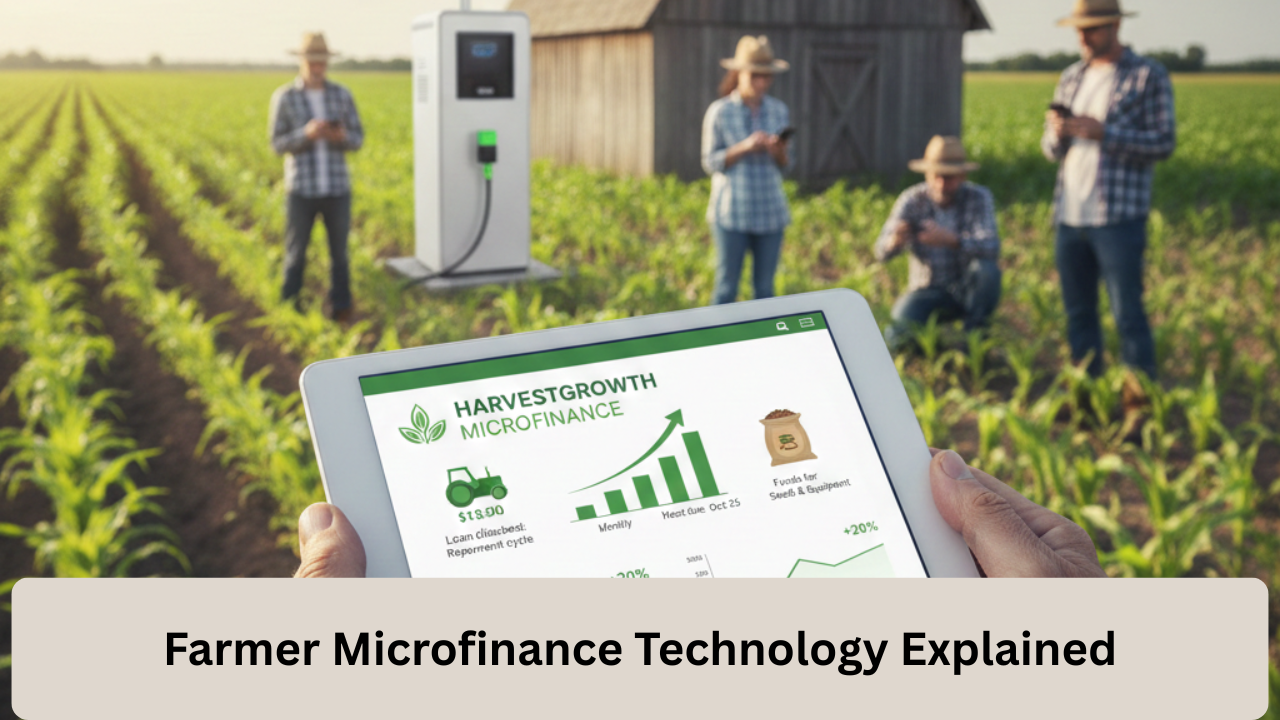
Farmer Microfinance Technology Explained. Agriculture may taken as one of the greatest sustenances to the food security of the planet and the rural workforce. However, on the one hand, farmers, especially the smallholders, constantly being faced with financial barriers, which, in their turn, suppress their productivity, innovation, and resilience.
The Farmer microfinance technology has revolutionized the technology to become a game changer in technology by integrating the financial services with the technology tools to make it more accessible, efficient, and sustainable. The microfinance institutions are changing the manner in which farmers utilize capital, risks, and fit within the modern agriculture value chains through technology.
Information on the Essential Purpose of Microfinance
The primary cause of the existence of microfinance is to provide financial services to individual people and members of the community who not usually served by formal banking. Its major operation is to offer small-scale loans, savings services, insurance, and payment services to the populations with low income that lack collateral and credit history.
This access is quite critical to farmers because the seasonal aspect of income and uncertainly produced harvests can render them ineligible for conventional financing. Microfinance ensures financial inclusion and economic empowerment other than providing credit. It allows farmers to invest in seeds, manure, machinery, and labor at the right time as opposed to them having to go to informal lenders who tend to charge very high interest rates.
Technology has now incorporated and through the mobile platform, microfinance services can now be accessed the remote rural areas and it reduces the administrative costs and increases transparency. Microfinance has therefore evolved beyond a simple lending mechanism to a development tool that will lead to long-run economic stability.
The importance of Microfinance to Agricultural Development
Microfinance would be strategic in empowering the agricultural sector due to the special needs of the agricultural sector as far as finances are concerned. Farming is hazardous in nature due to climate change, pests, and the dynamic market prices. Agricultural-specific microfinance institutions package products as per the planting and harvesting cycles, which allow repayment schedules that are adaptive to the cash flow of farmers.
This has enhanced by the application of technology that has seen lending decisions made on data. Using digital records, lenders are able to obtain information about farm operations, satellite images, and mobile transaction history that would allow them to narrate more regarding creditworthiness.
This will reduce risks of default and allow the farmers with limited formal documentation to access funds. Besides, microfinance has been employed to integrate the value chain since farmers not the only beneficiaries, but rather suppliers, processors, and distributors also financed to create a more robust agricultural ecosystem.
Microfinance Lending Principle of five Cs
There are five Cs of microfinance, which are significant concepts in the evaluation of the borrowers, as well as responsibly lent money. These postulates apply particularly in agricultural finance, where margins tend to be low and the risks are higher.
- The former C is Character, which is the reputation, reliability, and commitment of the borrower to repayment. This is periodically reviewed in communities that rural-based with the assistance of local networks and digital records of transactions. Technology helps in formalizing appraisal of character through repayment behavior and financial effort in the course of time.
- The second C is Capacity, which is the ability of the person taking the loan to repay the loan. This will mean evaluating projected crop production, diversification of the markets and market availability to the farmers. Capacity estimation with the help of digital tools and farm data analytics allows the lenders to estimate capacity more accurately in comparison to the traditional methods.
- The third C is Capital, which refers to the amount borrowed by a farmer for the farming operation. It does not make people less dependent and addicted to depending on loans; even minor personal investments will demonstrate interest and commitment. Microfinance institutions often put up the savings program as a way of increasing the capital base of farmers.
- The fourth C is Collateral but in microfinance, it is usually unconventional. Holding group guarantees, crop insurances, or even future harvest contracts used by the lenders instead of land titles or physical properties. With the help of technology, it is possible to introduce new ways of collateral, e.g., digital warehouse receipts or blockchain-based traceability.
- The fifth C, Conditions, considers market trends, climate, and policy factors, enabling providers to forecast risks and adjust lending.
Innovating a Sustainable Future for Farmers
Farmer microfinance technology does not imply access to finance in general but a solution to agricultural development, which is sustainable. It applies inclusive finance conjunction with digital innovation, where farmers given the opportunity to invest without having the fear of taking risks and access the markets the modern way.
The microfinance will play an ever-increasing role in strengthening the rural economies with the ever-changing technology, enhancing food security, and contributing to environmentally friendly farming practices. The future of agriculture is not in the enhancement of seeds and equipment but rather in the creation of more intelligent finances that place the farmer at the center of sustainable development.