

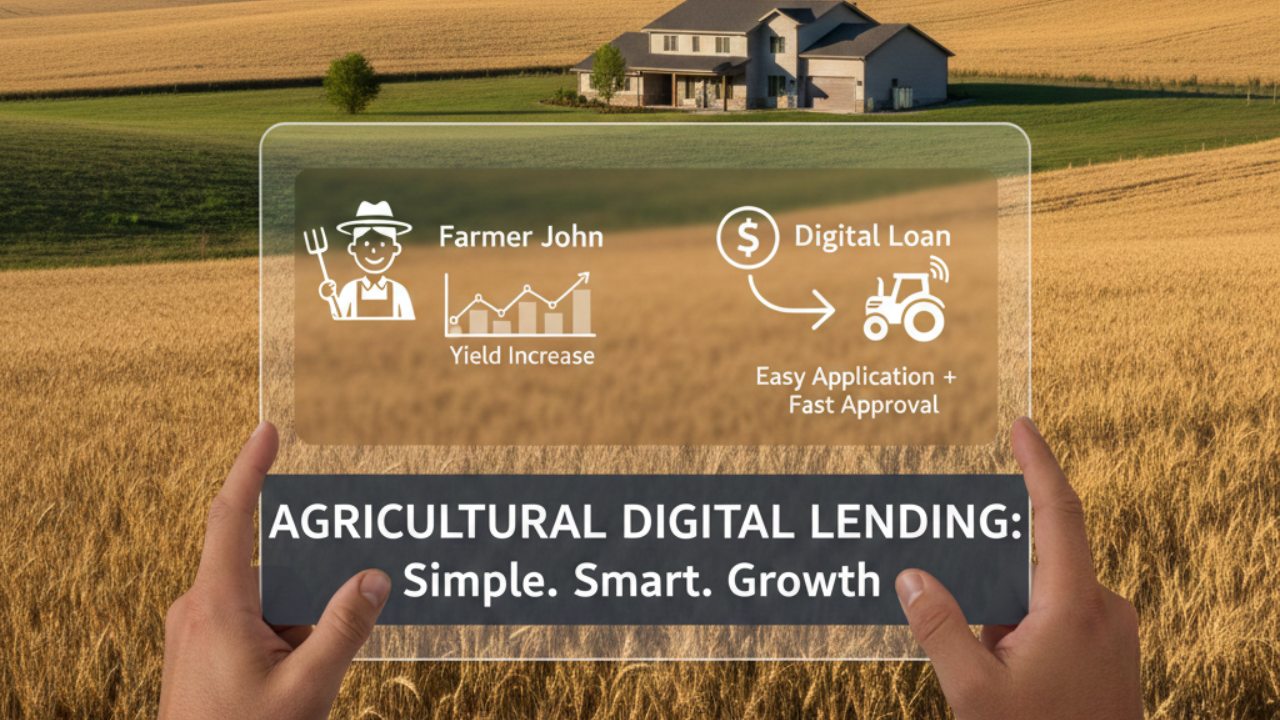
Agricultural Digital Lending Explained Simply. Farming is the greatest component of most economies, especially in the developing areas, where farmers provide jobs, food security, and stability in the rural areas. There is, however, one thing that farmers never fall short of and that is accessing fast and inexpensive loans. The old agricultural financing has been slow, cumbersome, and inaccessible to smallholders lacking official credit histories or collateral.
This approach has started to transform this field within the recent few years because of digital innovation. The alternative that can be used is online lending to farmers, which uses the latest technology, and incorporating financial services to deliver to farmers a more inclusive way.
As digital tools are expanding in the rural environment, there has been a noticeable shift in agricultural funding of small scale and massive magnitude. Understanding how digital lending works, how technologies facilitate this process, and learning the basics of lending will help you appreciate why this model will become increasingly important for the future of farming.
Conceptualization of the Digital Lending
Digital lending is the process of borrowing, lending and issuing, and approving loans via digital platforms as opposed to physical banks. The online services or the digital agents also enable the borrowers to take the loans without necessarily having to step into the bank and fill out a lot of paperwork.
This process is transformed in agriculture into digital lending to fit the farmers. The farmers usually need seeds, fertilizers, tools, or laborers on a seasonal basis. They do not have revenue cycles that are the same as those of people who receive a salary. The digital lending platforms based on alternative data and process automation to determine how one considered creditworthy, taking into account these facts.
One of the most important factors that define digital lending is speed. Previously, securing a loan would take weeks, but now it can happen in just a few days or hours. Automation also saves money in the administration that allows lenders to issue small loans that they would have thought were not worth the cost. This makes the digital lending very convenient for the small farmers that need small amounts of money on a short-notice basis.
Digital technologies are powering modern farming.
The farming ecosystem should have a greater adoption of digital technologies, so agriculture may be able to take up digital loans. These technologies have aided in creating data that the lenders can utilize to better actualize the risk and create financial products that address the needs of farmers in reality.
The most popular is mobile technology. Under the mobile money services, farmers can use basic and smart phones to fill out loan applications, get payments, and repay loans. Mobile connection has emerged as a very important instrument for offering access to finance to individuals in distant areas.
The other important technologies include the satellite images and remote sensing. The tools can assist the lenders in tracking the condition of crops, land use, and farm acreage without going to the field. Satellite data will help lenders make better loan decisions by showing the potential yield and risks from weather or soil conditions.
Looking behind the Curtains of Lending
To fully understand digital lending, it is essential to grasp the basics of lending. In lending, one will always lending money to an individual and he will required to pay it back later, usually with interest. The lender is paid back for the risk, time, and cost of doing business.
There are risks of loans in agriculture. The farmer would be able to pay back based on the following factors: crop failure, change of prices, and change of weather. The traditional lenders might demand security or excessive interest rates in their efforts to cushion themselves against such risks, making it hard to borrow funds for the small farmers.
This process will be changed through digital lending that will make it easy to realize the risk instead of merely shifting it to the borrowers. Real-time and forecasting models enable lenders to optimize loan terms according to the farmers’ revenue streams. The repayment schedule aligned with the timing of the harvests, and the loan amount correspond to the expected production levels.
The Future of Farming in the Significance of this Model
Alongside an innovative approach of obtaining funds, farming digital lending is a step towards better data-driven farming economies. Digital lending facilitates superior decisions on the part of farmers and more trusted investments and allows farmers to do more by connecting finance and the real farming.
As climate change is on the rise, the population is rising, and the issue of food security is also of concern, good agricultural financing becomes all the more important. Digital financing is an expandable and flexible approach that will go to farmers regardless of their location, be it technology or funds.
Finally, agricultural digital lending will only work out in case it is user-friendly and convenient. The ease with which farmers can access money enhances the rural community and strengthens the agricultural industry. This dynamic paradigm shows that technology and finance brought together to enable agriculture to evolve a way that will not only ecologically friendly but also equal to everyone.