

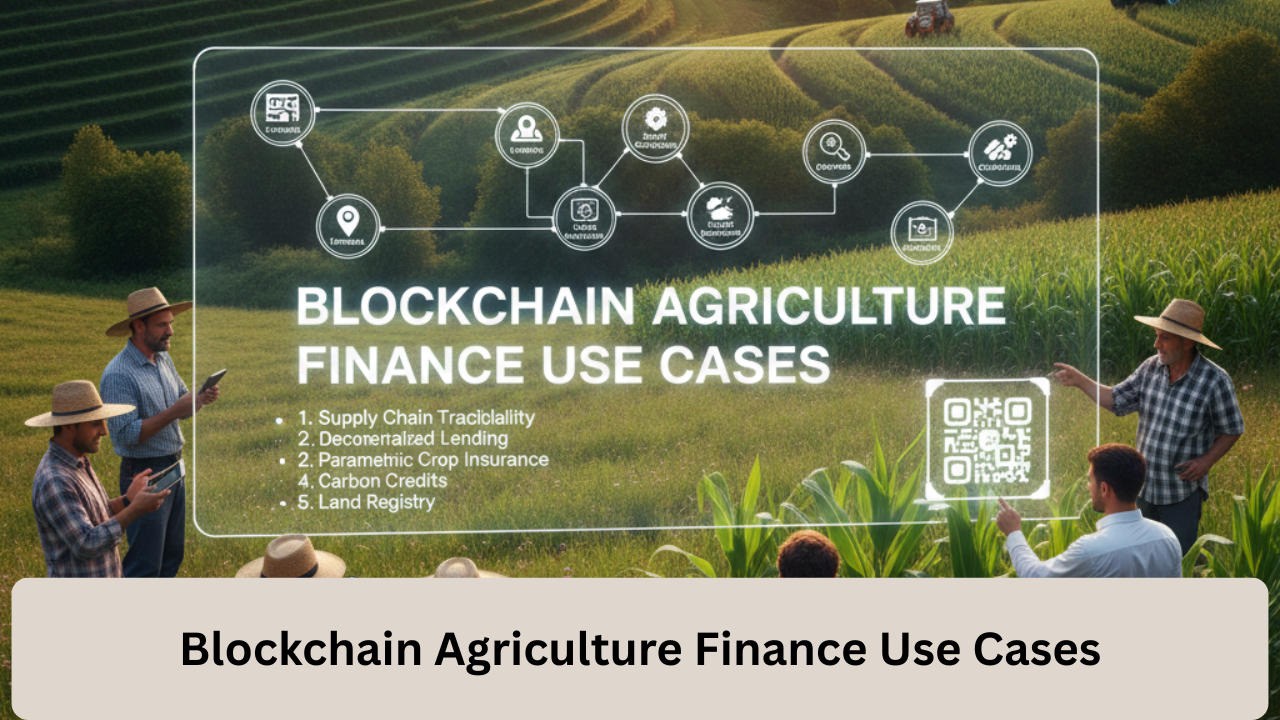
The agricultural sector is radically digitizing, requiring farmers, agribusinesses, and financial institutions to have more efficient, transparent, and inclusive financial solutions. One of the brightest technologies that generates this change is blockchain. Originally designed to deal with cryptocurrencies, blockchain has become a powerful tool to transform the farming finance model by eliminating.
Traditionally, agriculture has faced persistent obstacles such as limited access to credit, lack of transparency, high transaction costs, and deep-rooted distrust across the value chain. In response to these long-standing challenges, blockchain-based agriculture finance use cases demonstrate how decentralized and tamper-resistant systems can effectively reorganize capital flows within the agricultural ecosystem.
Blockchain is, at its simplest, a distributed registry technology, a technology that records transactions safely and publicly among multiple parties. This feature has particularly been beneficial to the agricultural financing field, where real-time data transfer deployed to reduce fraud and foster increased trust between lenders, farmers, and buyers; insurers and buyers; and regulators.
Increasing Farmers access to credit
One of the most impactful usages of blockchain in agriculture finance is the improvement of access to credit by farmers. The access to loans is normally a problem for the smallholder farmers due to the poor credit histories, limited documentation, and perceived risks. The blockchain platforms can develop unremovable digital identities of farmers using land use rights, production history, transaction history, and repayment habits.
The established pieces of information can be assuredly shared with the financial institutions, where financiers will able to assess the creditworthiness more effectively. Smart contracts used to automate the process of loan disbursement when the agreed-upon conditions have been met, e.g.,
The verified planting activities or delivery contracts. This will make the approval process much shorter and the administrative cost of the same is also reduced, and the lenders able to cater to the rural population that has been neglected.
Maximizing Supply Chain Financing
Supply chain financing is another critical area that the blockchain agriculture finance use cases are picking. Agricultural supply chains complicated and obscured by the fact that they possess multiple intermediaries. Information asymmetry and payment delay would usually strain the cash flows of the farmers, especially during the harvesting and planting seasons.
This is done through the application of blockchain-based platforms to track goods between the market and the farm open-ended manner. Financiers place their trust in transactions recorded in the blockchain when the delivery notices or quality certifications recorded in the blockchain.
It allows the banks and fintech companies to provide invoice financing or receivables financing at a reduced risk. This is good, as farmers and agribusinesses get easy access to working capital and lenders have confidence that they will get real-time verifiable information.
Smart Contracts of Funding of inputs
The output in agriculture is reliant on the input funding because the farmers need to have access to the seeds, fertilizers, pesticides, and equipment in good time. The latter supported with the help of blockchain smart contracts that can allow financing to linked to input suppliers. As an example, a smart contract programmatically pay a supplier of fertilizers upon delivery to the farm confirmed on the blockchain.
Such a mechanism will ensure that the money spent only on productive activities that would restrict possibilities of misappropriation and default. It also boosts the confidence of the farmers, suppliers, and financiers. The historical operations over time leave a good record of finances in the increase of future accessibility of finance by farmers. In the long run, this transparent financial record will be a good digital asset to farmers.
Any confirmed transaction, repayment, and input purchase gradually builds credibility within a farmer’s financial track record, which lenders can use to assess risk more accurately. Over time, this growing level of trust reshapes lending relationships. As trust increases, farmers receive faster loan approvals, more favorable financing terms, and access to a wider range of financial products.
The Way to Sustainable Agricultural finance
The application of blockchain in agricultural finance illustrates how technology can effectively address long-standing inefficiencies in rural financial systems. In this context, the adoption of blockchain marks a significant shift how agricultural transactions and financing managed. By enabling greater access to credit, improved risk management, and more efficient supply chain support.
As more people embrace the usage and regulatory frameworks evolve, the blockchain application respect to financial solutions destined to dominate sustainable agriculture, food security, and rural development the globe. Nevertheless, there are no challenges in the successful implementation of agricultural finance based on blockchain.
Such problems as lack of digital literacy in farmers, poor internet coverage in rural areas, and high initial productivity of the technology can impede a rapid adoption. Moreover, regulatory risk and absence of harmonized systems within a different region can be an impediment to cross-border applications and investor confidence. These barriers should overcome by governments acting jointly.