

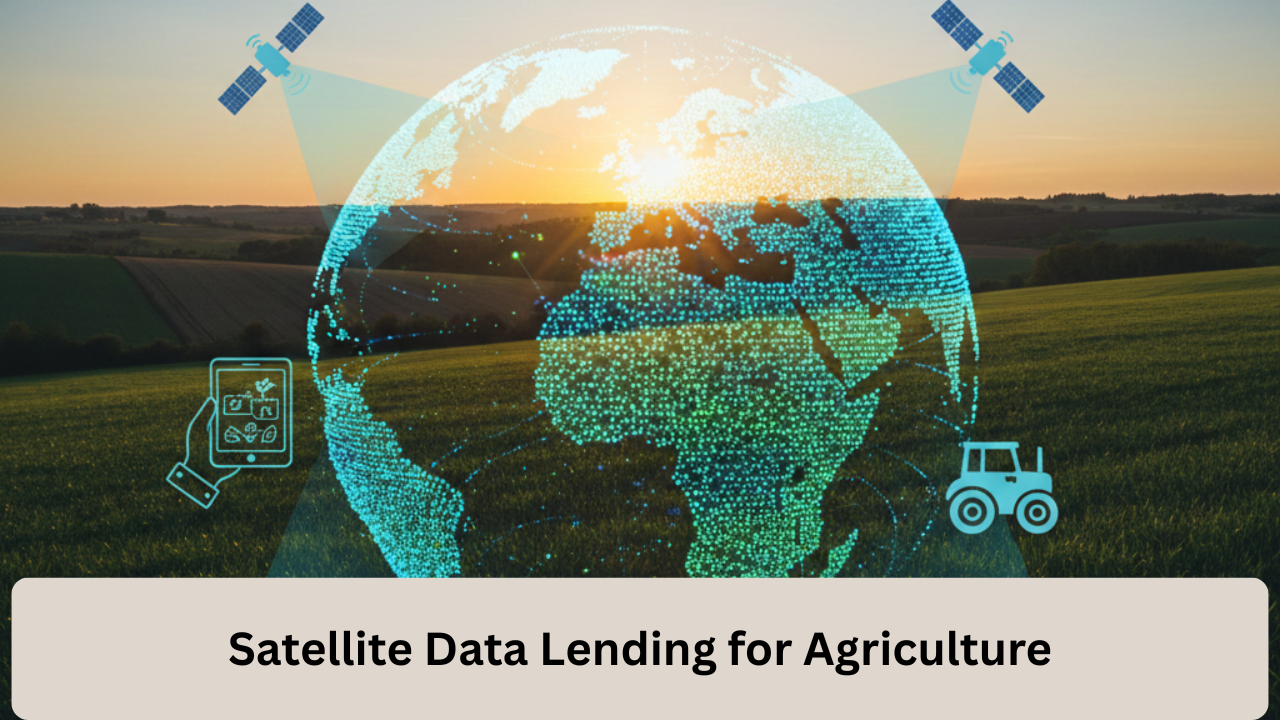
The issue of farming was always closely intertwined with information: the experience of the earth, weather, water, and state of crops assist in determining whether the farming season will profitable or not. This information collected and used differently nowadays due to satellite technology. One of the most exciting things that is in this change is the satellite data lending to agriculture—a system.
Which agriculture-based financial services based on information collected by satellites are provided, particularly for agricultural credit and agricultural lending? By establishing less uncertainty and greater transparency, satellite data lending is changing the process of accessing finance and risk management by the lenders to the farmers.
The services that come with agricultural credit are credit scoring, loan origination, and post-disbursement monitoring with the assistance of satellites. With satellite images, lenders are able to confirm ownership of land or land use, determine the type of crops planted, estimate the acreage planted and determine the health of crops growing during the growing season.
The Agricultural loans dilemma
It has been perceived that lending in the agricultural sector is risky. Farmers exposed to weather, pests, diseases, and market price changes, which are unpredictable. It does not come easy to the lenders, especially the banks and microfinance institutions, to identify the creditworthiness of the farmers due to low documentation, poor land records, and unreliable estimation of the yields.
In the developing regions, the greatest impact is on smallholder farmers who make up a good percentage of the agricultural labor. Many of them do not have access to formal credit and forced to take on informal credit, for which they incur high interest. The option of power in this region is satellite data. The inadequacy of information between the farmers and the lenders.
Eradicated with the assistance of satellite data on information, which is objective, timely, and scalable in the context of farmland and crops. The use of satellite information gives lenders the capability to assess the agricultural practices with some degree of precision that has hitherto been impossible using traditional mechanisms. Through the detection of these indicators, which include crop vigor.
What Is Satellite Data Lending?
Satellite data lending is implementing satellite photographs and analytics to help in agricultural funding. Satellites quantify the use of land and the vitality of its vegetation, soil moisture, amount of precipitation, and agricultural production stage. This data is then subjected to geospatial analytics, artificial intelligence (AI), and machine learning models order to generate insights that specifically applied to lending.
Lenders will be able to use such insights to:
- Determine the size and fidelity of farmland.
- Monitor crop development throughout growth.
- Establish preharvest output.
- Assess the past productivity and climatic risks.
- Early notification on crop failure.
Lenders are able to get continuous real-time information on the agricultural operations as compared to relying on self-reports or on the rare field visits.
Satellite Data as a tool of Improving Credit Assessment
Among the most significant advantages of sharing satellite data on credit risk, one may include enhanced credit risk assessment. The lenders shall have the opportunity to evaluate the performance of a particular piece of land in the different seasons through the historical satellite data.
The continuous vegetation growth and consistent yield patterns are signs of lower risk and frequent exhibitions of crop distress are signs of higher risk respectively. Satellite-based vegetation indices, such as the Normalized Difference Vegetation Index (NDVI), used in the determination of crop vigor and biomass.
Incorporation of weather data will assist lenders to forecast the projected yields and revenues more accurately. This allows them to scale down the amount of loans, the interest rates, and the repayment plan to what the farmer can afford. Satellite data can also serve as a credit profile to smallholder farmers who have no formal credit history, a so-called digital farm footprint.
The Future of Lending Satellite Data
It is estimated that the lending of the satellite data will increase exponentially as the price of the satellite technology continues to fall down and as its features continue to increase. The combination of satellite data with the Internet of Things (IoT), mobile banking, and AI-powered credit models is also going to increase the accuracy and availability.
In the future, the field of agricultural lending may be virtually entirely data-driven, with insights appearing in real-time so as to be able to make a financial decision along the farming cycle. The growth has the potential to open up billions of dollars of agricultural financing, particularly by small farmers who have in the past marginalized by the formal systems.
This will also promote more personalized, adaptive financial products, as the lending process will be more real-time and data-driven. Conditions of the loan, interest rates, and repayments can also dynamically changed in accordance with live sites like crop growth, weather, and market prices. Consequently, farmers not confined as before to feudal types of financing systems.